Q algebraic sum of heat transfer between system and surroundings. An object with mass m subjected to a net force will have acceleration equal to the.
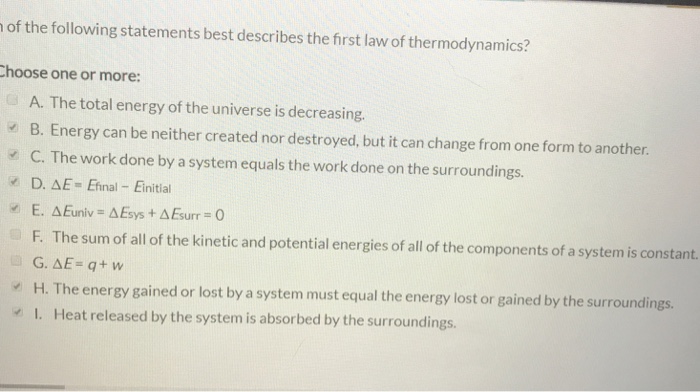
Solved Which Of The Following Statements Best Describes The Chegg Com
Energy transfers are 100 efficient in changing energy from one useful form.
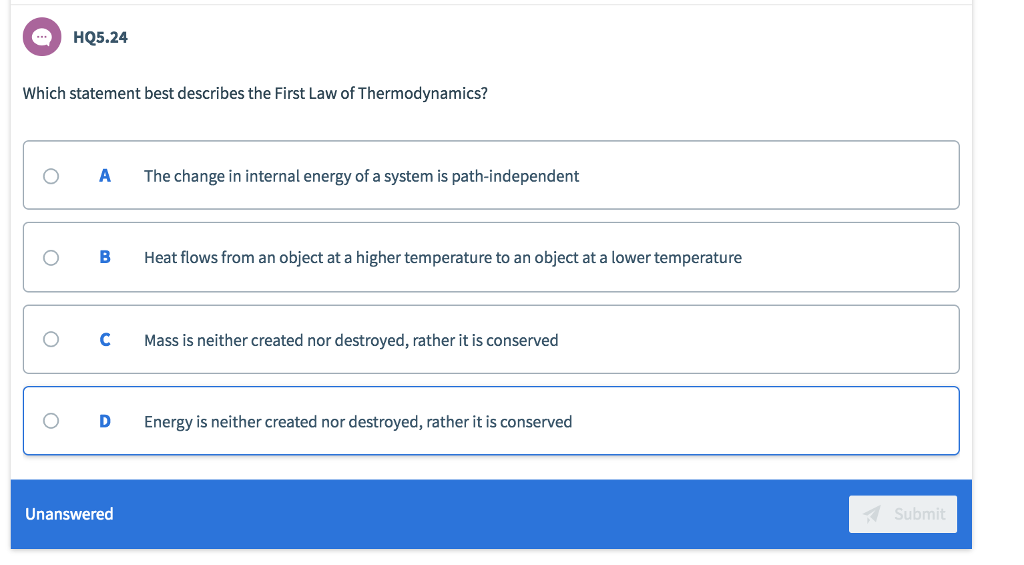
. Metabolism manages the increase of entropy in an organism. O A The change in internal energy of a system is path-independent OB Heat flows from an object at a higher temperature to an object at a lower temperature C Mass is neither created nor destroyed rather it is conserved. The change in thermal energy of a system is equal to the difference between the thermal energy transferred minus the work transferred.
It is also known as law of conservation of energy. The first law of thermodynamics is a version of the law of conservation of energy adapted for thermodynamic processes distinguishing three kinds of transfer of energy as heat as thermodynamic work and as energy associated with matter transfer and relating them to a function of a bodys state called internal energy. Which statement best describes the first law of thermodynamics.
First law of thermodynamics. The law of conservation of energy states that. The first law of thermodynamics states that every energy transfer involves a loss of usable energy the so-called heat tax.
The First Law of Thermodynamics states that energy can neither be created nor destroyed but it can only be. Some energy always dissipates during physical and chemical changes. It can only be redistributed or changed from one form to another.
The first law of thermodynamics states that the change in internal energy of a system equals the net heat transfer into the system minus the net work done by the system. Which of the following statements accurately describes the changes that occur in this reaction. Where ΔU change in internal energy of the system.
Some useful energy is lost as heat whenever an energy transfer occurs. In equation form the first law of thermodynamics is ΔU Q W. States that energy can not be created or destroyed.
3rd Law of Thermodynamics A perfect crystal at zero Kelvin has zero entropy. The equation for the first law of thermodynamics is given as. What is stated by the First Law of Thermodynamics quizlet.
Which best describes the first law of thermodynamics. The first law of thermodynamics. Which of the following statements best describes the first law of thermodynamics.
Chemistry questions and answers. Heat is a form of kinetic energy. The First Law of Thermodynamics states that energy can be converted from one form to another.
The first law of thermodynamics states that the change in internal energy of a system equals the net heat transfer into the system minus the net work done by the system. HQ524 Which statement best describes the First Law of Thermodynamics. What best describes the first law of thermodynamics.
The first law of thermodynamics also known as Law of Conservation of Energy states that energy can neither be created nor destroyed. Energy can neither be created nor destroyed but it can change into matter. In other words energy cannot be created or destroyed.
Which of the following statements BEST describes Newtons second law of motion. Which of the following statements best describes the change that occurs. The force acting on an object is equal to its mass times its acceleration.
Here ΔU is the change in internal energy U of the system. Energy can be created from matter or. The object is either at rest or it moves with constant velocity when there is no net force acting on it.
It change its form from one to another. 1st Law of Thermodynamics Energy cannot be created or destroyed. It states the energy neither be created nor destroyed.
Consider the thermodynamic properties of chemical reactions. Metabolism uses all of an organisms resources. Metabolism consists of all the energy transformation reactions in an organism.
The law of conservation of energy. Some useful energy is lost as heat whenever an energy transfer occurs. 11th - 12th grade.
Energy can neither be created nor destroyed but it can change from one energy form to another. What is the first law of thermodynamics in chemistry. Energy can only be transferred or changed from one form to another.
Metabolism depends on a constant supply of energy from food. As the gas expands in the cylinder the piston is seen to move upwards. ΔU q W.
2nd Law of Thermodynamics For a spontaneous process the entropy of the universe increases. W work interaction of the system with its surroundings. Which best describes the first law of thermodynamics.
Energy cannot be created or destroyed. Energy is not created nor destroyed but it can change from one energy form to another. The first law describes how thermal energy is conserved but not the direction it moves.
In equation form the first law of thermodynamics is ΔU Q W. Asked Apr 18 2021 in Biology Microbiology by Sagat. It is given by the formula Where - change in internal energy - heat added - work done by.
The change in thermal energy of a system is equal to the thermal energy that is transferred to the system or from the system. The statement which best describes the difference between the first law of thermodynamics in comparison with the second law of thermodynamics is that. Atoms cannot be created or destroyed.
Which of the following statements best describes the first law of thermodynamics. First Law of Thermodynamics Equation. Solar energy is converted into chemical energy in living systems.
First Law of Thermodynamics DRAFT.
What Is The 1st Law Of Thermodynamics Quora
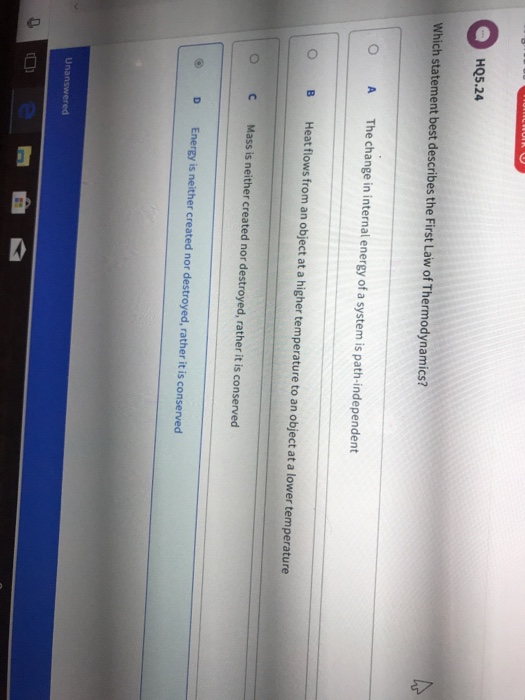
Solved Hq5 24 Which Statement Best Describes The First Law Chegg Com
Solved Hq5 24 Which Statement Best Describes The First Law Chegg Com



0 Comments